the problem
In high-growth B2B scale-ups, the marketing website almost always starts as a folder inside the product monorepo. It seems convenient at seed stage, but by Series A or B, it turns into an expensive operational bottleneck.
Every routine marketing request—updating pricing tiers, adding partner logos, publishing comparison pages, or testing ad variants—turns into a Jira ticket assigned to senior full-stack engineers. Product roadmaps stall, marketing campaigns sit blocked behind two-week release cadences, and deploy rollbacks on marketing copy risk breaking production authentication.
the next.js hydration tax
Most SaaS marketing sites built on modern React frameworks ship full application runtimes for what is fundamentally editorial content.
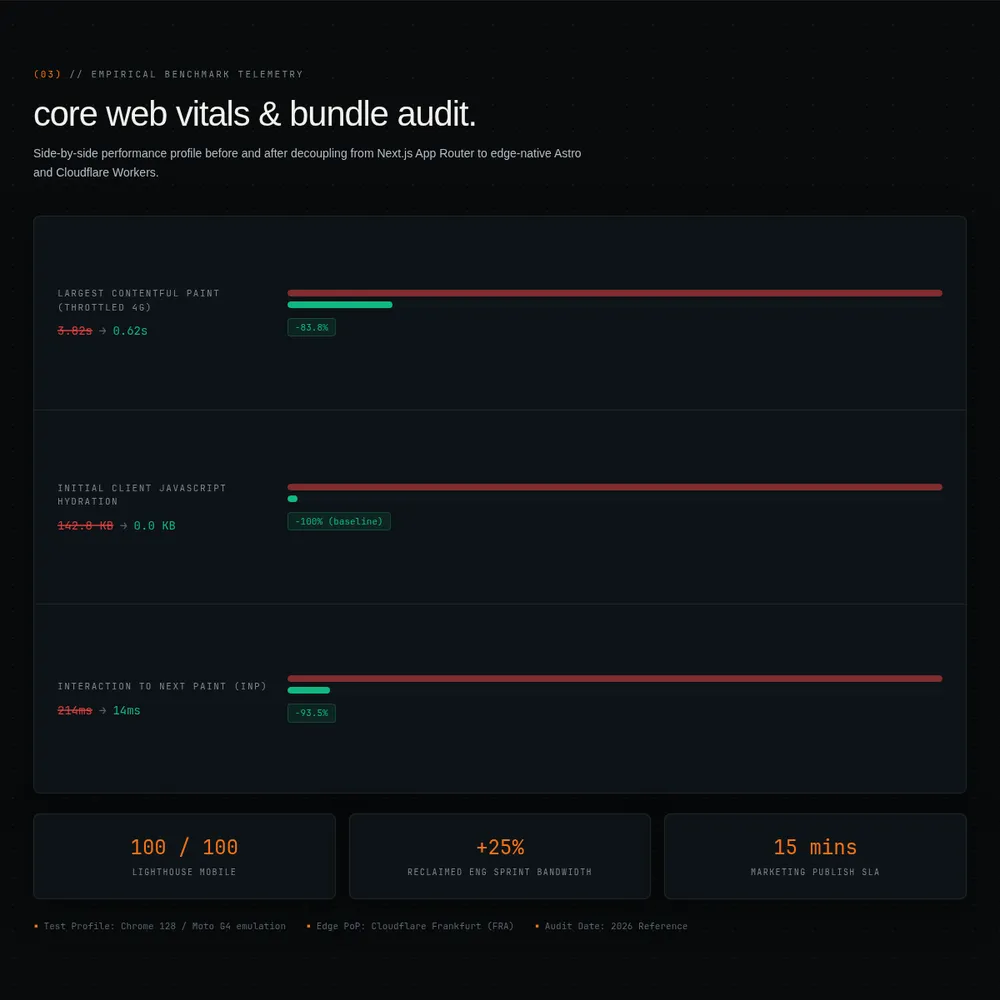
Visiting an enterprise pricing or feature page pulls down over 140 KB of minified React runtime and component trees that must hydrate on the main thread before buttons and links respond. On throttled mobile devices used by executives traveling or reviewing links between meetings, mobile Largest Contentful Paint (LCP) degrades to 3.8 seconds, and Interaction to Next Paint (INP) triggers warnings in Google Search Console.
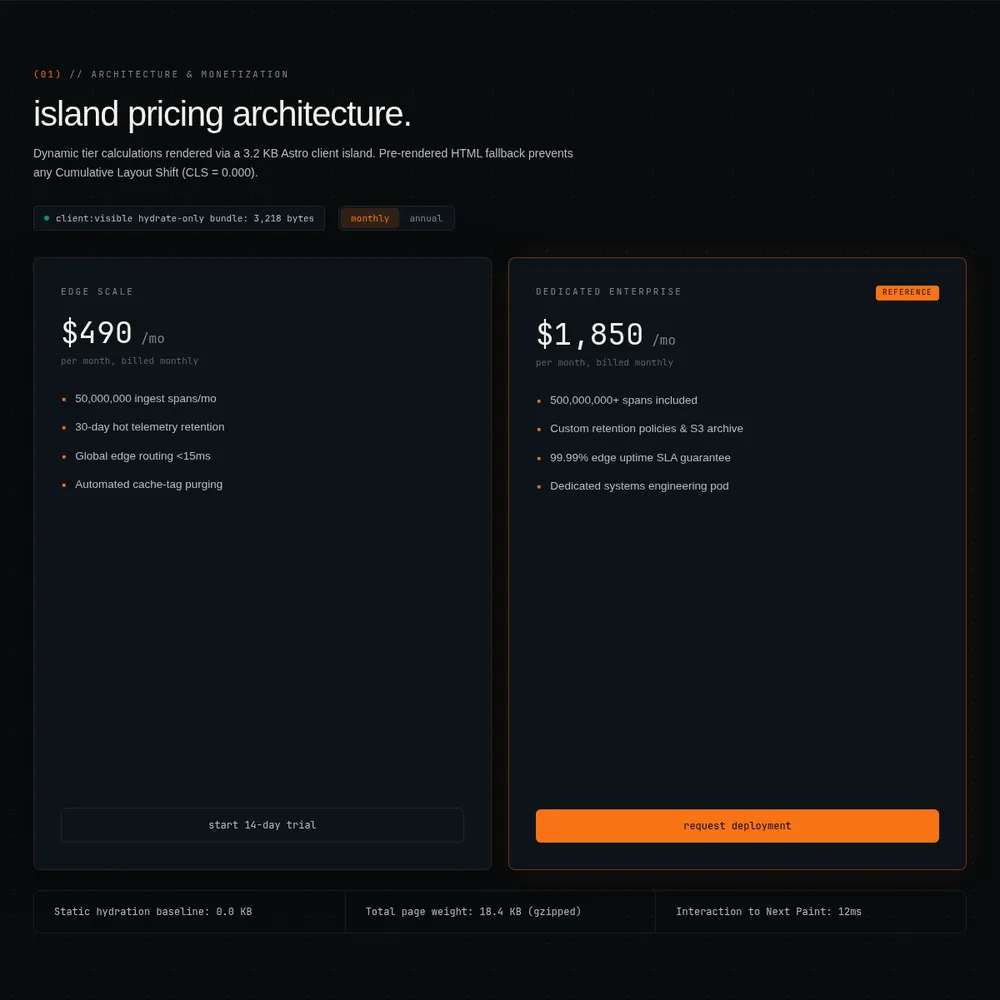
Apex replaces that runtime overhead with an edge-native Astro baseline. Content, navigation, and documentation compile to 0 KB of client JavaScript. Interactive elements—like a dynamic annual-monthly pricing tier calculator—are isolated into lightweight Astro islands hydrated only when scrolled into view (a 3.2 KB island payload), preserving instant interactivity without penalizing initial page weight.
15-minute publishing without developer tickets
Marketing teams should never wait for an engineering sprint to update a headline or publish customer social proof.
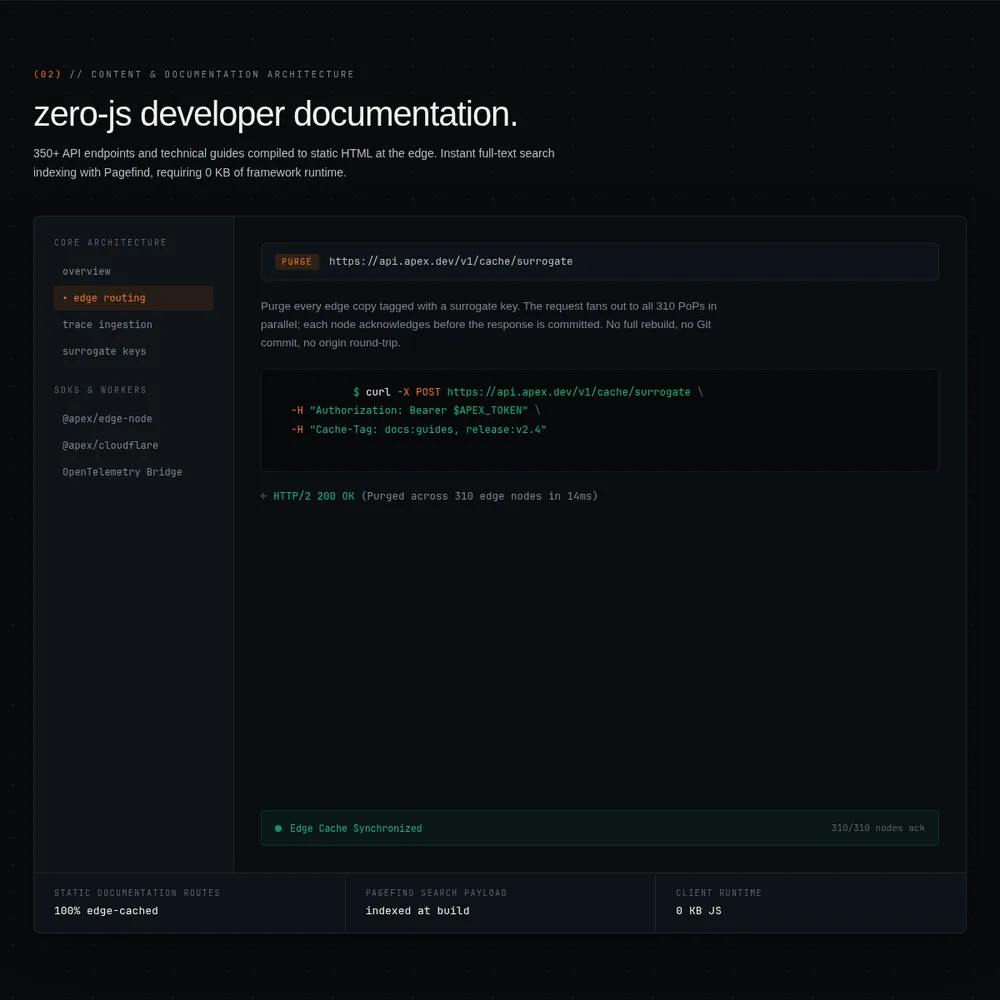
With Storyblok structured components mapped directly to Astro layouts, marketing operators drag verified design-system blocks into place, edit copy in a live visual preview, and publish immediately. Changes trigger automated webhook calls that purge specific edge cache tags on Cloudflare in under 15 milliseconds, without initiating a full site rebuild or requiring a Git commit.
ad clicks convert on speed, not spinners
Enterprise SaaS customer acquisition costs (CAC) continue to climb. When a targeted LinkedIn campaign or Google search ad directs high-intent prospects to a landing page that stalls for 3 seconds on mobile, up to 40% of those clicks bounce before reading the value proposition.
Apex delivers complete page renders in 0.62 seconds on throttled 4G connections. Instant load times multiply the return on paid acquisition spend, so every media dollar buys real prospect engagement instead of mobile bounce-off.
flat infrastructure overhead
Next.js serverless functions and dynamic image optimization scale computing costs aggressively under bot crawls and traffic spikes.
By distributing pre-rendered static assets across Cloudflare’s global edge network with surrogate-key cache invalidation, Apex achieves a 99.4% cache hit ratio. Origin compute is called only when webhooks actively invalidate changed content. Global response latency drops below 25ms, and hosting costs remain predictable and flat regardless of visitor volume.
the benchmark numbers
| Metric |
Legacy Monolith (Next.js SSR) |
Apex (Astro + Cloudflare) |
Delta |
| Mobile LCP (throttled 4G) |
3.82s |
0.62s |
-83.8% |
| Initial client JavaScript |
142.8 KB |
0.0 KB (3.2 KB island) |
-97.8% |
| Lighthouse mobile score |
48 / 100 |
100 / 100 |
+52 pts |
| Interaction to Next Paint (INP) |
214ms |
14ms |
-93.5% |
| Engineering time on marketing |
20–25% sprint capacity |
0 hours (marketing self-serve) |
Reclaims 1 eng FTE / mo |
| Publishing turnaround |
5–7 days (dev backlog) |
15 minutes (direct in CMS) |
Same-day GTM velocity |
| Edge cache hit ratio |
64.2% |
99.4% |
Origin compute eliminated |